How to Choose Your First Automatic Watch: The Collector's Blueprint
A practical guide to movement architecture, case proportions, and enduring value.
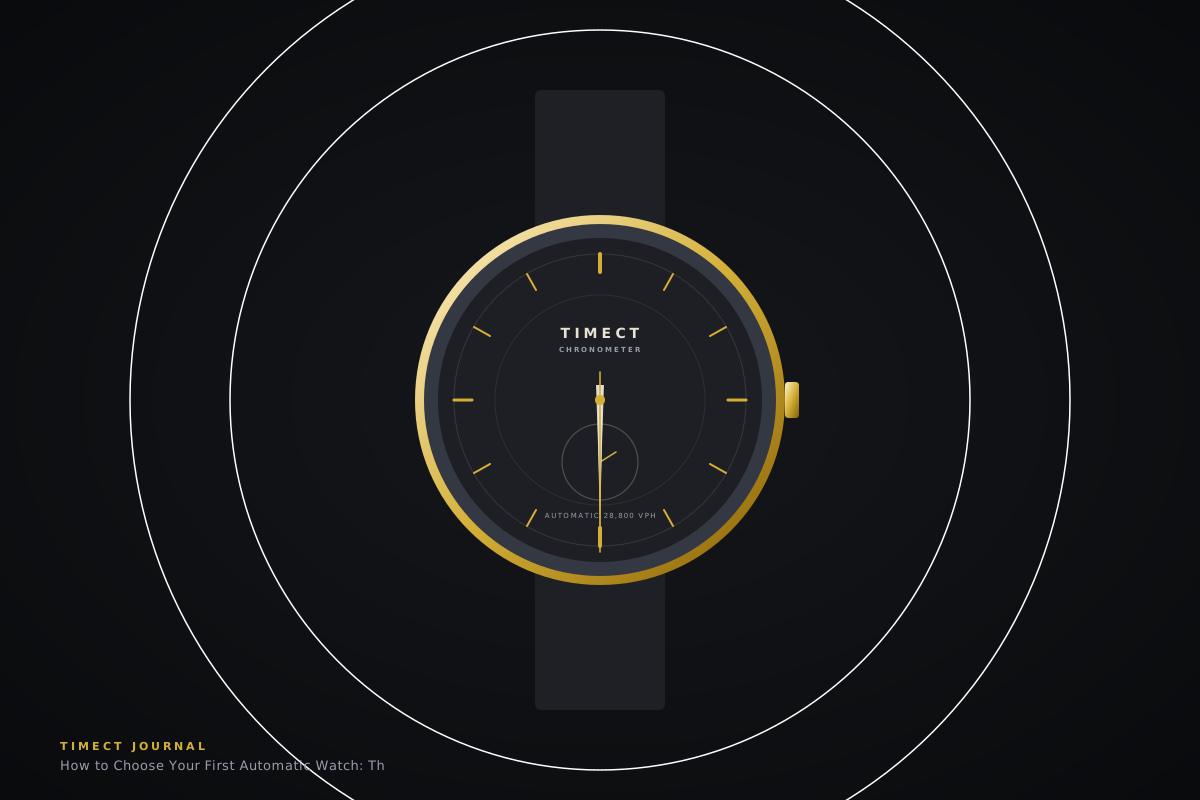
Choosing your first automatic watch comes down to three crucial parameters: movement reliability (such as a high-beat 28,800 vph caliber with 40+ hours power reserve), wearable proportions (typically 38mm–41mm diameter and under 12.5mm thickness), and durable materials like 316L stainless steel and scratch-resistant sapphire crystal.
Choosing your first automatic watch comes down to three crucial parameters: movement reliability, wearable proportions, and durable materials like 316L stainless steel and scratch-resistant sapphire crystal.
1. Understanding the Self-Winding Caliber
Unlike quartz timepieces powered by silver-oxide batteries, an automatic watch harnesses kinetic energy from natural wrist movements. A weighted semicircular rotor swings freely, winding the mainspring coiled tightly within the barrel. Look for a movement that beats at 21,600 or 28,800 vibrations per hour (vph), providing a smooth sweeping seconds hand and reliable chronometry.
2. Case Dimensions & Lug-to-Lug Distance
Case diameter only tells half the story. The lug-to-lug distance—the vertical measurement from top horn to bottom horn—dictates whether a watch will overhang your wrist. A 40mm watch with 47mm lug-to-lug wears comfortably on almost all wrist circumferences between 6.25 and 7.5 inches.
Key Takeaways for First-Time Buyers
- Insist on sapphire crystal with anti-reflective coating on the underside.
- Look for water resistance of at least 50m (5 ATM) for safe daily washing.
- Choose a versatile dial palette (matte black, sunburst silver, or deep navy).
3. Long-Term Ownership and Servicing
A well-engineered mechanical watch does not become obsolete. With preventative service intervals every 4 to 6 years—refreshing synthetic lubricants and water gaskets—an automatic timepiece will outlive digital smartwatches by generations.
Horological Benchmark Specifications
Engineering Tolerances
Regulated in 3 to 5 positions; isochronism variance limited to +/- 4 to 8 seconds per day.
Material Composition
Austenitic 316L stainless steel, anti-magnetic alloys, synthetic sapphire with internal anti-reflective coating.
Escapement Frequency
28,800 vibrations per hour (4 Hz) or 21,600 vph (3 Hz) providing optimal balance longevity.
Preventative Maintenance Cycle
Pressure testing every 24 months; comprehensive ultrasonic overhaul every 4 to 6 years.
In-Depth Technical Evaluation: Micro-Mechanical Nuances
When assessing how to choose your first automatic watch: the collector's blueprint, the true differentiator lies in microscopic finishing and kinetic efficiency. The interaction between the balance hairspring and the pallet fork gems determines whether a timepiece maintains stability over multiple decades. High-grade synthetic rubies (corundum jewels) are polished to minimize frictional drag at pivot points, while synthetic epilame coatings prevent lubricant migration away from the escape wheel teeth.
Curator's Verdict & Acquisition Advice
For both aspiring enthusiasts and seasoned collectors, understanding the architectural pedigree behind this timepiece ensures lasting ownership satisfaction. Rather than chasing transient design trends, invest in pieces characterized by proportional harmony, serviceability of internal components, and transparent manufacturing provenance.
Editor's Summary Note
Horology remains one of the few physical crafts where traditional centuries-old hand finishing merges seamlessly with modern aerospace tolerances. Treat your timepiece with regular care, keep it shielded from high magnetic fields, and it will serve as a multi-generational companion.
Common Questions & Guidance
How often does an automatic watch need winding?
If worn daily for 8-10 hours, wrist motion keeps it fully wound. If left untouched past its power reserve (typically 38 to 48 hours), gently wind the crown 20 to 30 turns to kickstart the balance wheel.
Can I wear an automatic watch while playing sports?
Light sports and swimming are fine if rated for 100m water resistance, but avoid heavy high-impact vibrations such as golfing or operating jackhammers to protect the balance staff.